

Executive Summary
Today, Washington State residents are exposed to an air shed characterized by a huge amount of air toxics, a group of pollutants associated with undesirable health effects. These air toxics are mainly generated by on-road gasoline and diesel vehicles.
The Federal Environmental Protection Agency (EPA) estimates health risks caused by air toxics via a study called National Air Toxics Assessment (NATA). According to one of the most recent studies of Washington State Department of Ecology (WSDE), if people were exposed to air toxics at 1999 levels throughout their whole lives, there is a possibility that about 1,400 people would contract cancer attributable to air toxics.
In Washington State, amongst the components of air toxics, diesel particles are the most significant and cause great risks for air pollution-associated cancer development. Infants, elderly and pregnant women are more vulnerable to diesel particles.
Time has come to phase out health problems generated by air toxics.
Context and Importance of the Problem
In the United States, the national Clean Air Act (CAA) requires the EPA to set the National Ambient Air Quality Standards (NAAQS) for harmful pollutants to human health and the natural environment. These standards aim at protecting vulnerable populations such as asthmatics, children, pregnant women, and elderly people.
Besides the NAAQS, Washington State and the Puget Sound region have elaborated regional standards which are summarized in the following table.
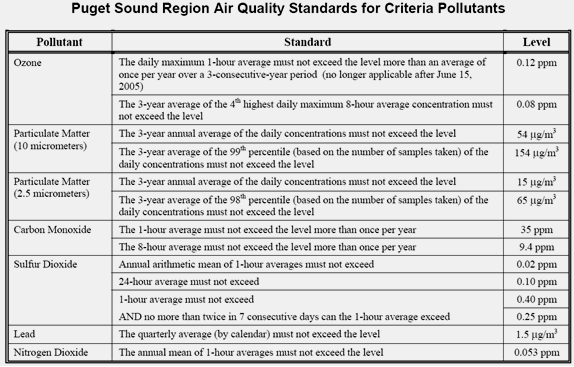
TThe EPA has set the federal standard to 65μg/m3, while in the Puget Sound Region the standard is capped at 25μg/m3. In general, the EPA and environmental agencies set standards based on Particulate Matters 2.5 and 10 (PM2.5/10).
Particulate Matter 2.5 (PM2.5)
Federal environmental laws stipulate that particles smaller than 2.5 micrometers are considered “fine”.
PM2.5 is one of the major air pollution concerns affecting Washington State residents’ health. It is generated by vehicle exhaust, wood burning, and other area sources.
Exposure to PM2.5 can lead to serious health effects. “Fine” particles are known for causing lung problems, heart disease, and premature death.
Particulate Matter 10 (PM10)
Particles bounded by 2.5 and 10 micrometers are called “coarse”.
PM10 includes both “fine” and “coarse” particles. “Coarse” particles are well known for causing severe respiratory problems such as asthma.
Critique of Policy Options
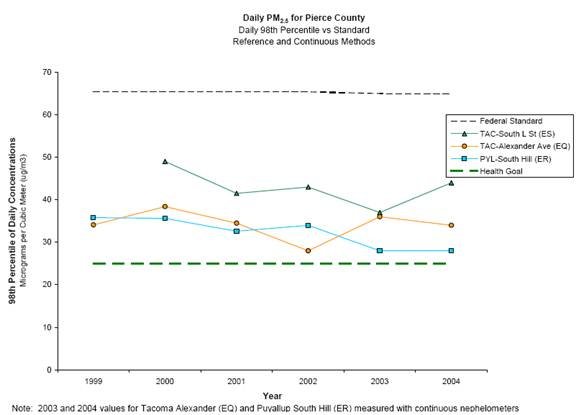
The Washington State Clean Air Agency (WSCAA) has been successful in keeping its air quality standard below the one set by the EPA. However, in most Counties the amount of air toxics present in the air shed is above the health goal.
The following graph illustrates the example of Pierce County.
Currently, Washington State Department of Ecology (WSDE) is putting a lot of effort into reducing air toxics present in the air shed.
Since it has been reported that diesel-powered vehicles generate about 52 percent of air toxics, WSDE has devoted most of its 2004 policy to diesel particles reduction.
School Bus Retrofit Program
The agency has worked with the Washington School Bus Program to retrofit 3,581 school buses to prevent children from exposure to diesel particles.
Heavy-Duty Diesel Vehicle Retrofits
Through a grant program, the WSDE helped Washington State Cities and Counties retrofit heavy-duty diesel vehicles.
In addition, the program helped equip government-owned buses with electric plug-ins.
Policy Recommendation
The policy adopted by the WSDE is not efficient in reducing air toxics in the short run.
Action needs to be taken now.
Through academic research and collaborations with experts in the field, I have elaborated an alternative policy proposal comprised of three main steps to control air toxics.
First, this alternative policy recommendation would propose ways to acquire Washington State residents’ willingness to pay for pure and healthy air quality.
Second, implement strategies that could reduce or eliminate air toxics in the short and long-run.
Finally, explain why this policy alternative works better than the existing one.
Contingent Valuation Method (CVM)
This is a survey approach used by Environmental Economists to evaluate individuals’ willingness to pay (WTP) for selected environmental initiatives.
This would consist of sending out a survey to Washington State residents that could be formatted as follows:
- Give an overview of air toxics and how they can affect their health.
- Provide current data on illnesses caused by air toxics in Washington State.
- Acquire their willingness to pay for more sustainable air quality.
- Acquire their opinion and support about changing the existing policy.
- Provide a tentative Cost/Benefit analysis for implementing this new policy proposal.
- Acquire their overall support or rejection of this alternative policy.
This survey would not only show them that the proposed policy change takes into consideration and values their health and wellbeing, but also relies on their support to solve an existing public health problem.
Air Toxics Reduction Strategies
Improve the Public Transportation System
To reduce the amount of diesel particles released in the air, Cities and Counties must work on retrofitting their buses and other diesel-powered vehicles.
Doing so would decrease the overall amount of diesel particles released into the air.
Create Incentives for Carpooling
Washington State roads are filled with one-person occupied vehicles.
Therefore, increasing gasoline particles released into the air.
I would recommend implementing tax breaks and gasoline subsidies to promote carpooling.
Carpooling would not only decrease traffic congestion but would also contribute to reducing air contamination.
Promote Hybrid-Type Vehicles
Washington State could use part of its residents’ tax dollars to promote hybrid vehicles in the form of subsidies for manufacturers and tax breaks for buyers.
This strategy would also contribute to reducing air toxics released into the atmosphere.
SOURCES
http://www.pscleanair.org/airq/basics/airtoxics.aspx
http://www.pscleanair.org/airq/basics/psate_final.pdf
http://www.pscleanair.org/airq/basics/NATA%20Overview%202006%20Feb%20Release.pdf
http://www.pscleanair.org/news/library/reports/2005AQDSFinal.pdf
http://www.epa.gov/ttn/atw/allabout.html
Frequently Asked Questions (FAQ)
What are air toxics?
Air toxics are hazardous air pollutants that can cause serious health problems, including respiratory diseases, cardiovascular conditions, and certain types of cancer. In Washington State, vehicle emissions are among the primary sources of air toxics.
Why is air quality an important issue in Washington State?
Air quality directly affects public health, environmental sustainability, and quality of life. Exposure to polluted air can increase the risk of asthma, lung disease, heart conditions, and premature death, particularly among vulnerable populations.
What is PM2.5 and why is it dangerous?
PM2.5 refers to fine particulate matter measuring 2.5 micrometers or smaller. These particles can penetrate deep into the lungs and bloodstream, increasing the risk of respiratory illnesses, cardiovascular disease, and other long-term health problems.
How do diesel emissions affect public health?
Diesel emissions contain toxic particles and chemicals that contribute significantly to air pollution. Long-term exposure may increase the risk of cancer, respiratory diseases, and other health complications, especially for children, elderly individuals, and pregnant women.
What are the main sources of air toxics in Washington State?
The primary sources include:
- Diesel-powered vehicles
- Gasoline-powered vehicles
- Industrial activities
- Wood burning
- Other combustion-related emissions
Transportation remains one of the largest contributors to air toxics in many parts of Washington State.
What is the Contingent Valuation Method (CVM)?
The Contingent Valuation Method (CVM) is an economic survey tool used to measure how much individuals are willing to pay for environmental improvements. In this policy proposal, CVM helps assess public support for initiatives aimed at improving air quality.
How can public transportation help reduce air pollution?
Modern and efficient public transportation systems can reduce the number of private vehicles on the road. This helps lower fuel consumption, decrease emissions, and improve overall air quality.
Why is carpooling considered an effective solution?
Carpooling reduces the number of vehicles traveling on the roads, which lowers traffic congestion, fuel consumption, and air pollutant emissions. It is a practical strategy for improving air quality while reducing transportation costs.
Can hybrid vehicles contribute to cleaner air?
Yes. Hybrid vehicles generally consume less fuel and produce fewer emissions than conventional vehicles. Encouraging their adoption through incentives and tax benefits can help reduce air toxics and improve air quality.
What actions can policymakers take to improve air quality in Washington State?
Policymakers can:
- Strengthen emission reduction programs
- Modernize public transportation systems
- Promote carpooling initiatives
- Support low-emission and hybrid vehicles
- Increase public awareness about air pollution and health risks
- Invest in long-term air quality monitoring and research
By Issa Ndiaye | Principal and CVO at OVINDI International Group