
Introduction: Two Worlds, One Choice
Growing up in Senegal, I witnessed a reality that millions around the world know too well: a society where opportunity is determined not by talent, determination, or vision, but by geography, privilege, and access.
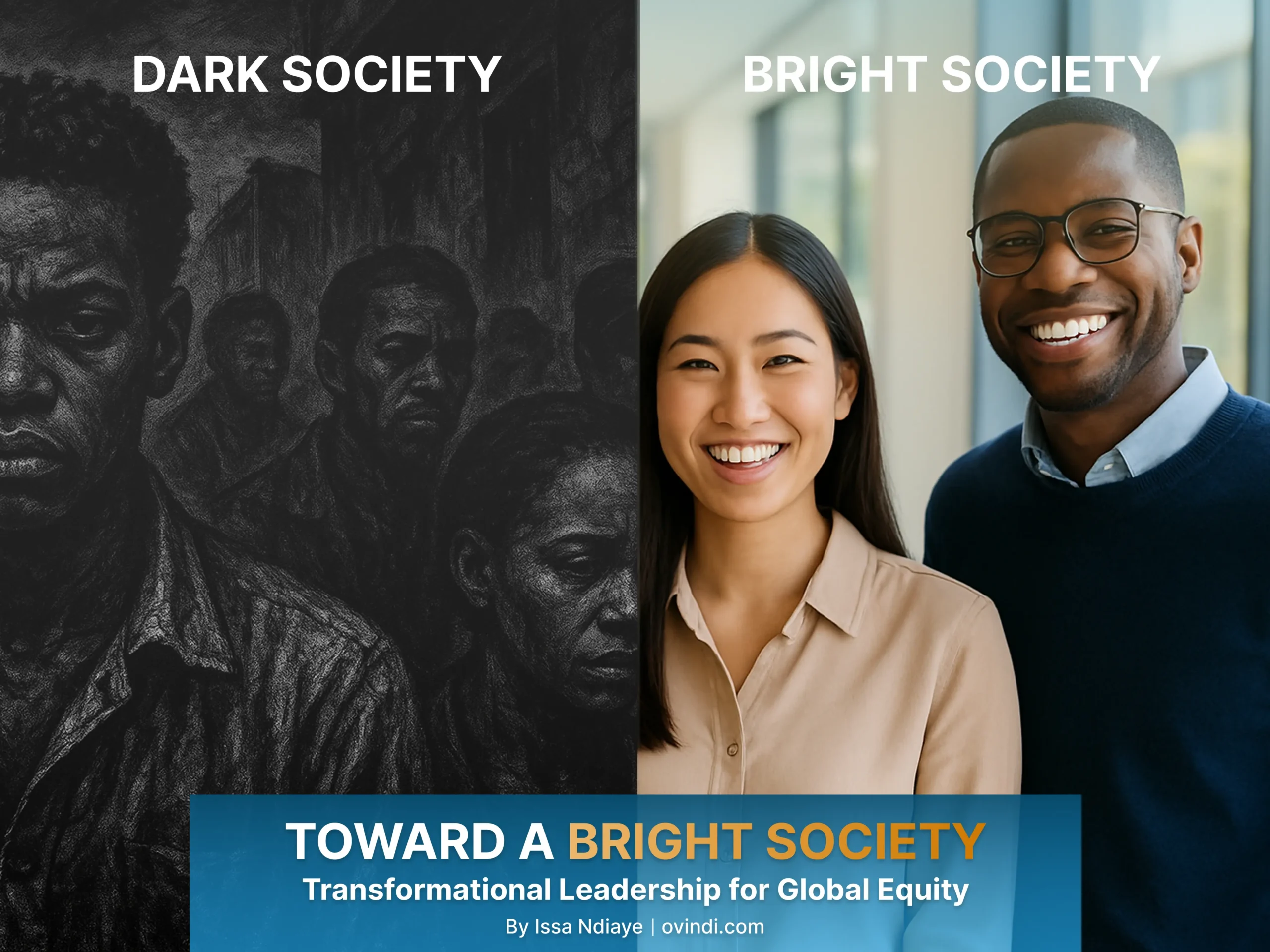
I call this the “Dark Society”—a world characterized by systemic inequality, limited opportunities, and leadership that serves the few rather than the many.
When I immigrated to the United States, I didn’t just cross an ocean. Instead, I crossed into a different reality—one with more resources, more opportunities, and more possibilities. However, I also saw that even in places of abundance, the Dark Society persists. In fact, inequity exists everywhere, taking different forms but rooted in the same fundamental problem: a failure of leadership.
Consequently, that realization became the foundation of OVINDI and our guiding vision: building a Bright Society.
What Is the Bright Society?
The Bright Society isn’t a utopian dream or an abstract ideal. Rather, it’s a tangible, achievable reality built on three pillars:
1. Equity Over Equality
Equality gives everyone the same resources. However, equity recognizes that people start from different places and provides what each person needs to succeed.
In a Bright Society, access to education, economic opportunity, healthcare, and leadership development isn’t determined by zip code or last name. Instead, it’s available to all who seek it.
2. Ethical Leadership
Leadership in the Dark Society is transactional: “What can I gain?” In contrast, leadership in the Bright Society is transformational: “What impact can I create?”
Ethical leadership prioritizes:
- Integrity over shortcuts
- Long-term impact over short-term profit
- Collective progress over individual gain
- Transparency over opacity
3. Strategic Global Partnerships
No leader, organization, or nation can build the Bright Society alone. Therefore, it requires collaboration across borders, sectors, and cultures.
The Bright Society is built on partnerships that:
- Bridge divides rather than deepen them
- Share knowledge and resources equitably
- Create sustainable, scalable solutions
- Center the voices of those most affected
From Dark to Bright: The Role of Transformational Leadership
The transition from Dark Society to Bright Society doesn’t happen by accident. Moreover, it doesn’t happen through policy alone, or technology alone, or good intentions alone.
Instead, it happens through transformational leadership.
What Makes Leadership Transformational?
After years of working with leaders across continents—from grassroots organizers in West Africa to C-suite executives in North America—I’ve identified four core characteristics of transformational leaders:
1. Vision-Driven
Transformational leaders see beyond the present. In fact, they paint a compelling picture of what’s possible and inspire others to pursue it.
However, vision without action is just a dream. Therefore, transformational leaders translate vision into strategy, strategy into action, and action into measurable impact.
2. People-Centered
Systems don’t change themselves. Rather, people change systems.
Consequently, transformational leaders invest in developing others. They build capacity, transfer knowledge, and create pathways for the next generation of leaders.
At OVINDI, we call this “leadership multiplication”—when one transformed leader goes on to transform ten others, who each transform ten more.
3. Ethically Grounded
In the face of challenges, shortcuts can be tempting. Nevertheless, transformational leaders understand that how you achieve your goals matters as much as what you achieve.
Furthermore, ethical leadership builds trust. Trust builds relationships. Subsequently, relationships create sustainable change.
4. Globally Connected
The challenges we face—climate change, economic inequality, public health crises—don’t respect borders. Similarly, neither can our solutions.
As a result, transformational leaders think globally while acting locally. They build bridges across cultures, leverage international networks, and recognize that our fates are interconnected.
The OVINDI Approach: Making Transformation Tangible
At OVINDI, we don’t just talk about transformational leadership—we cultivate it.
Indeed, our work operates at three levels:
Individual Leadership Development
Through personalized coaching, we work one-on-one with leaders to:
- Clarify their vision and values
- Develop strategic thinking capabilities
- Strengthen decision-making under complexity
- Build authentic influence
- Create measurable impact plans
Importantly, our coaching isn’t generic. It’s tailored to each leader’s context, challenges, and aspirations.
Organizational Capacity Building
We partner with organizations—from nonprofits to corporations—to:
- Assess leadership culture and gaps
- Design custom leadership development programs
- Facilitate strategic planning processes
- Build cross-functional collaboration
- Implement systems for sustainable growth
Global Network Facilitation
We connect leaders, organizations, and communities across borders to:
- Share best practices and lessons learned
- Create strategic partnerships
- Access resources and opportunities
- Amplify collective impact
After all, the Bright Society isn’t built in silos. Rather, it’s built through connection.n.
Why Now? The Urgency of Transformation
We’re living in a pivotal moment. Indeed, the challenges are immense:
- Growing economic inequality within and between nations
- Climate crisis threatening the most vulnerable first
- Democratic institutions under strain
- Rapid technological change outpacing ethical frameworks
- Persistent systemic racism and discrimination
However, I’m not pessimistic. Instead, I’m determined.
Because I’ve also seen:
- Young leaders across Africa creating innovative solutions to local challenges
- Social entrepreneurs building businesses that prioritize impact alongside profit
- Communities organizing for change and winning concrete victories
- Cross-sector partnerships achieving what governments couldn’t alone
Consequently, the building blocks of the Bright Society already exist. What we need is leadership to connect them, scale them, and sustain them.
From Senegal to Seattle: My Journey as a Lesson
My own journey embodies the transition I advocate for.
I could have accepted the limitations of the Dark Society—the idea that where you’re born determines where you end up. Instead, I chose to pursue education, to learn multiple languages (Wolof, French, English), to build bridges between cultures, and to create opportunities not just for myself but for others.
Admittedly, that choice wasn’t easy. Immigration is hard. Building something new is hard. Challenging systems is hard.
However, here’s what I’ve learned: Hard isn’t the same as impossible.
Similarly, every leader I work with faces their own version of this choice. Will you accept the status quo, or will you work to transform it?
Ultimately, the Bright Society is built one choice at a time, one leader at a time, one action at a time.
What the Bright Society Looks Like in Practice
Let me be concrete. Indeed, the Bright Society isn’t just a philosophical concept. Rather, it has real-world manifestations:
Education Systems
- A young person in rural Senegal has access to the same quality online learning as someone in Silicon Valley
- Leadership development starts in schools, not just executive suites
- Education equips people to think critically, not just to follow instructions
Business Practices
- Companies measure success not just in profit but in social impact
- Supply chains are transparent and equitable
- Leadership reflects the diversity of the communities served
Governance Structures
- Public servants see themselves as stewards, not rulers
- Policies are designed with input from those most affected
- Accountability is the norm, not the exception
Community Life
- Resources are distributed based on need, not just political power
- Different cultures and perspectives are valued, not merely tolerated
- Everyone has a voice in shaping the future
This isn’t fantasy. In fact, these examples exist in pockets around the world. Therefore, our work at OVINDI is to make them the norm, not the exception.
Your Role in Building the Bright Society
You don’t need to be a CEO or a president to contribute to the Bright Society. Rather, you need to be a leader—and leadership exists at every level.
Here’s how you can start:
1. Define Your Vision
What does the Bright Society look like in your context? In your organization? Your community? Your family?
2. Assess Your Leadership
Assess Your Leadership Are you leading with integrity? Are you developing others? Are you creating sustainable impact?
3. Build Your Network
Who are the other leaders, organizations, and movements aligned with building a Bright Society? Moreover, how can you connect and collaborate?
4. Take Action
Start small but start now. Specifically, what’s one thing you can do this week to move from Dark Society toward Bright Society?
5. Stay Committed
Transformation isn’t a one-time event. Instead, it’s a daily practice. Some days will be hard. Nevertheless, keep going.
The OVINDI Invitation
At OVINDI, we’re not building the Bright Society alone—and we don’t want to.
Indeed, this is a collective endeavor that requires diverse voices, perspectives, and talents.
If you’re a leader who:
- Believes in equity over inequality
- Values integrity over shortcuts
- Seeks impact over personal gain
- Thinks globally while acting locally
Then you’re already part of this movement.
Whether you’re in Dakar or Dallas, Lagos or London, your leadership matters. Furthermore, your vision matters. Your choices matter.
How to Connect
I invite you to:
📧 Reach out if you’re interested in coaching or consulting
🤝 Connect with our growing network of transformational leaders
💬 Engage with our content and share your own insights
🌍 Commit to embodying the leadership the Bright Society needs
Visit ovindi.com to learn more about our programs, or connect with me directly on LinkedIn.
Conclusion: The Future We Choose
The Dark Society is not inevitable. Similarly, the Bright Society is not impossible.
Indeed, the difference between the two is leadership—the kind of leadership we choose to embody, support, and develop.
Every day, we make choices that move us toward one or the other. Consequently, every interaction, every decision, every investment of time and energy matters.
My journey from Senegal to founding OVINDI has taught me that transformation is possible. Not easy, but possible.
Furthermore, it starts with one person, one leader, one choice at a time.
The question isn’t whether you can contribute to building the Bright Society. The question is: Will you?
About the Author:
Issa Ndiaye is the Founder and Chief Visionary Officer of OVINDI International Group, a leadership development and strategic consulting firm dedicated to building what he calls the “Bright Society”—a world defined by equity, ethical leadership, and global collaboration. Born in Senegal and based in the United States, Issa is fluent in Wolof, French, and English, and works with leaders and organizations across continents to create sustainable, transformational change.
Connect with Issa on LinkedIn or visit ovindi.com to learn more.
By Issa Ndiaye | Principal and CVO at OVINDI International Group